
No barrier. No bench.
Most activities ask something first: read the music, know the rules, make the team. A drum asks nothing. There is no wrong way to begin, no skill to prove, no bench to wait on. We focus on process, not performance.
Every student has a seat, a drum, and a part to play from the very first session, which is why a drum circle welcomes every age, culture, and ability.
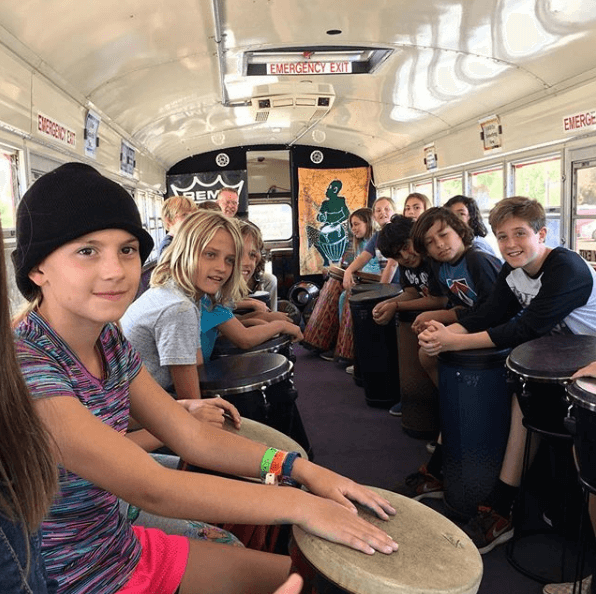
The beat does real work.
When students drum together, they are doing far more than making music. Keeping a shared beat asks the brain to listen, focus, and respond in real time. Playing in a circle asks students to listen to one another, take turns, lead, and follow.
And steady rhythm itself settles the body, giving energy somewhere to go and stress a way to ease. Connection, focus, and calm, all happening at once, all inside something that feels joyful.
Backed by research.
Every DrumBus® program is anchored in Beat the Odds®, an evidence-based, trauma-informed curriculum developed by the Arts & Healing Initiative, an organizational member of the UCLA Collaborative Centers for Integrative Medicine.
UCLA researchers have shown Beat the Odds® can significantly reduce behavior problems, such as those related to inattention, depression, post-traumatic stress, and anxiety.

What is nurtured in the circle.
Social and emotional.
Belonging, trust, and empathy through shared circles. Self-expression and emotional regulation. Confidence and leadership as students share rhythms. Lighter stress, lifted mood.
Cognitive.
Attention, focus, and working memory. Pattern recognition, sequencing, and timing. Listening and auditory processing. Creativity through rhythmic improvisation.
Physical.
Fine and gross motor coordination. Posture, breath control, and stamina. Safe sensory input that supports regulation and focus.
